Wednesday, March 30, 2011

"Egg Drop Challenge - Iteration #1"

Total number of achivements: 25


List of achievements:
Brainstorming-Create a sketch of one possible solution. Include labels. ++
-Create a sketch of another possible solution. Include labels. ++
-Create a sketch of a third possible solution. Include labels. ++
-Use a decision matrix to justify the approach you chose. ++


Material Prep-Generate a list of materials required for build day. ++
-Document a plan to ensure materials are brought in on block day. ++


Material Size:(your egg is not included in the material size)
(air is ubiquitous and not included in material size. "Rare" commodities like helium are.)

-Your materials fit inside a printer paper box ++
-Your materials fit inside a shoe box ++
-Your materials fit inside a cigar box ++
-Your materials fit inside an Altoids box ++

Material Weight:(your egg is not included in material weight)
-Your materials weigh less than 500 grams. ++
-Your materials weigh less than 300 grams. ++
-Your materials weigh less than 200 grams. ++
-Your materials weigh less than 150 grams. ++
-Your materials weigh less than 100 grams. ++
-Your materials weigh less than 50 grams. ++


Drop Accuracy:-You hit the butcher paper! ++

Egg Resilience:-Your egg broke but the yolk remained intact. ++
-Your egg cracked but the yolk stayed inside and intact. ++
-Your egg cracked but was still together. ++
-Your egg didn't break in any way! (awarded three times) ++


Communicate Results Achievements-
Create promotional materials for your design.++


  • In my class, there were only some designs that succeeded.
    • The paper beg as a parachute.
    • two balloons a the side to protect the egg.
    • A balloon inside a balloon, and the egg inside the inner balloon.
  • If we were to improve our design, we would use a paper bag as a parachute, instead of balloons.

Monday, March 14, 2011

Ted video blog


Go to TED.com and spend some time investigating the site.
Once you've had a chance to familiarize yourself with the webpage, answer the following questions:
1) What is the TED organization about?
The TED organization is about spreading good, and intresting ideas.
2) What is the purpose of their website and how does the functionality of their site support that?
To expose good ideas to the world.
3) As Engineers and Problem Solvers, which topic areas (the choices from the "Show talks related to:" section on the sidebar) are of most interest to us? Justify your answer.
We are intrested in knowing how stuuf works, and how it is made.
4) Based on your previous answer, what are 3 talks (videos) on the site that appear like they would be of most interest to you as an Engineer/Problem Solver? Justify your choices.
Ueli Gegenschatz soars in a wingsuit
Toaster out of scratch
Wireless electricity
5) Each student will watch a unique video. Claim your video on the following period specific posts: 2nd, 3rd, 4th, 5th. If no one else has claimed your video, leave a comment on that post to call the one you want. If someone else has already claimed the talk, go back and pick another one. Watch the video. Embed the video in your blog post and create a bulletized outline of the key issues presented in the talk.
  • A man who uses a wing suit instead of a parachute.
  • He does all  kind of "air" sports, but he likes the wing suit because it is more extreme.
  • wing suit goes up to a forward speed of 115mph and downward 45mph.

6) How could you get involved in the field/technology/issue you chose to hear about? What experience/skills/training/education would you need to learn to get involved with this field?
  • Call the organization, and get training to learn how to use the wing suit.
  • try to meet someone who does sky diving, para-gliding, or hang-gliding, like my dad who has done both para-gliding, and hang-gliding.
Part II of the TED activity will have you negotiate within a group to select the "best" video to represent the group. The student with the chosen video will receive extra credit. The group will then prepare a short presentation that summarizes the talk and will present to the class. The class will choose the best presentation and that group will receive extra credit.

Wednesday, March 9, 2011

Reverse Engineering: Mechanicnal Product - Functional Analysis


Perform an analysis of the Mechanical Product you selected for your Reverse Engineering efforts. Use the following procedure:


1. What is the purpose or primary function of the object?
To put or round up papers.
2. Make an educated guess as to how this product operates. Use simple machines’ terminology to explain the object’s sequential operation.
When the stapler is pushed down, the staple gets pushed out, and goes through the papers, and when the stapler trespasses, and hits the metal, it gets twisted, which makes it strap the papers together.
3. Identify the system inputs, intended product function, and outputs. Use power point to create a "black box" graphic like the toothbrush example discussed in class. Save the slide as a .jpg image and post it to answer this question.
4. What mechanical components are visible?
  • The lever arm
  • Staples
  • Staple advancer
5. What is it about this device’s function that you cannot identify, because the mechanical components are hidden from plain view?
The only thing that is not visible it the spring that grabs the stapler advancer.

Thursday, March 3, 2011

Reverse Engineering: Mechanical Product - Visual Analysis

  • Using a camera phone, digital camera or your laptop's webcam, take pictures of your product that correspond to a multi-view drawing (top, front, side).


  • Post these images to your blog. Identify your product and title each object view.
        For my mechanical product, I choose a stapler.

  •     Top View of the stapler.
        Front View of the stapler.
        Side View of the stapler.


  • Perform a Product Analysis


    • Visual Analysis
      • Describe the visible design elements and principles in relation to the three images of the product. 
      • In thus product, I can identify several visible design elements. The stapler shows color, shape, balance
    • Functional Analysis
      • What is the purpose of the product and how does the mechanical nature of the item support that? 
      • This product is used to put papers togrther,or seal papers. 
    • Analyze the target audience/demographics
      • People who work in a office, teachers, and students.


  • Draw a sketch of your chooseing (isometric, multi-view, etc.)


  • Label the sketch with dimensions and other relevant information


  • Post the sketch to your blog


  • Monday, February 28, 2011

    Egypt Opt-in


    Q - What technologies facilitated the regime change we witnessed in Egypt today? List 3. Describe how each technology came about and how each were used in support of the protest.   
    • I think that Face book helps them communicate with the outside world because they can expose the pictures they take, and talk to people around the world..
    • Also cameras helped them take pictures of the the bad things, and the brutalities in Egypt, so they can expose them to the world. The pictures could be exposed by face book.
    • And also cell phones, and the Internet helped them view and show the world the things that are happening.
    • Q - List each of the items displayed in the image. Make your best guess about how they could be re purposed to support peaceful demonstration in the face of an authoritarian regime.
    • I think the jacket is used for protection only.
    • The goggles could be used for eye protection from rocks and other things.
    • The flower could show that you are in peace.
    • You would need good shoes because you would be on your feet for a long time.
    • The spray paint could be used to do graffiti, and to make posters.
    • The top of a tin trash can could be used as a shield to protect yourself from rocks.
    • The bandanna could be used to protect yourself from tear gas.

    Wednesday, February 23, 2011

    Graphic Design


    • This advertisement came from the design news magazine.
    • This article is used to market inertial sensors used in Hollywood for movies like Iron Man.


    • This article does include message content, but does not have readability.
    • The article had a lot of info. Wich shows size.
    • The audience can easily identify, and understand the demographics.
    • The suit that is being marketed shows good color, shape, balance, lines, and texture.
    1. What are trends? Why is it important to identify them prior to graphic design?
    Dictionary.com says that trends are the general direction in which something tends to move. It allows companies to make their products seem more attractive.
    2. How does human nature play a role in how a product is marketed to a specific demographic group?
    Humans want stuff, which the different companies produce. According to the product's productivity, and the use of them in a people's daily life makes the companies produce more or less.
    3. How is a potential audience identified?
    By the age, race, sex, ethnicity, interests, activities, region and mostly demographics.
    4. What must you discover about the target audience prior to graphic design?
     You must discover what the audience likes, and wants to have.

    Desk organizer


    • For this project, we designed a desk organizer.
    • Some constraints that we had with the desk organizer was that:
      • We had to not let it attach to the desk.
      •  It could not exceed a 6" depth, 12" width, and a 10" height.
      • It must include a recessed area.
      •  And a bent plastic part with a 3/4" thick base.
      •  The last constraints was that it had to have hold six items and it had to have five different parts to it.
    • We chose  the desk organizer because it seemed like the most fun and the most interesting, for this, we followed a series of steps:
      •  For the first step, we defined the problem.
      • For the second step we brainstormed some ideas.
      •  For the third we came up with the best idea.
      •  For the fourth, we used the constraints to help shape our desk organizer so that we knew what not to do.


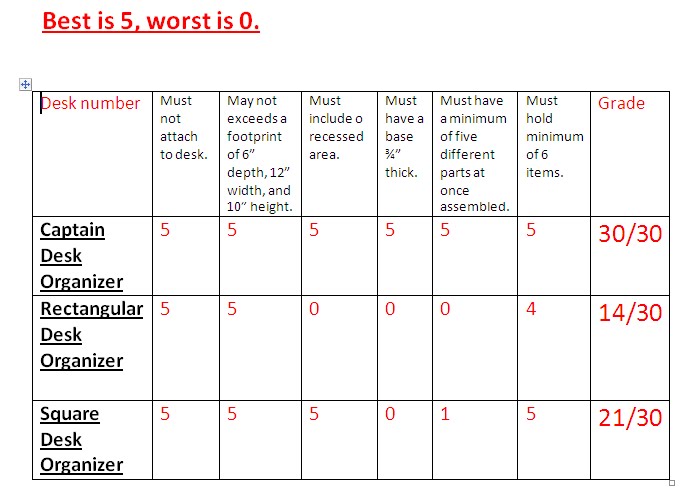
    For this desk organizer, which is called Captain Desk Organizer, it is the best one that we have. It maintains all of the requirements needed and is the best organized.


    The above desk organizer, the rectangular desk organizer, does not have 5 different parts or a recessed area. It does maintain the needed size and it does not attach to the desk.


    The above desk organizer, the square desk organizer, does not hold a minimum of 5 different parts and its base of more than 3/4" thick. It does meet all of the other standards though.


    • For the matrix, desk #1 was the best desk organizer that we had. It held up all of the requirements needed and it got a perfect score of 30/30.
    •  For the desk #2, it did not turn out as well as we wanted it to because all of the requirements weren't met. It only got a 14/30.
    • Desk #3 was a little better than 2 because it mostly met the requirements except for a couple. It got a score of 21/30.

    • This is our quality brochure for the desk organizer.